Farming is risky business.
An inherent part of farming, risk keeps growers on their toes, constantly balancing playing it safe with taking a chance. The more information and resources they have at their fingertips to make decisions, the better.
“Farmers contend with several factors that can make or break their operations,” said Brian Sorenson, executive director of the Minnesota Association of Wheat Growers. “Having an effective selection of tools in their toolboxes to mitigate that risk is important.”
Producers across the Upper Midwest have a new powerhouse backing their interests during critical farm policy conversations: the Agricultural Risk Policy Center (ARPC) at North Dakota State University. Using data-driven research and policy evaluation, ARPC delivers evidence-based insights that inform agricultural policy and support producers, policymakers, and industry leaders in managing economic risk, thereby building a stronger, more resilient rural economy.
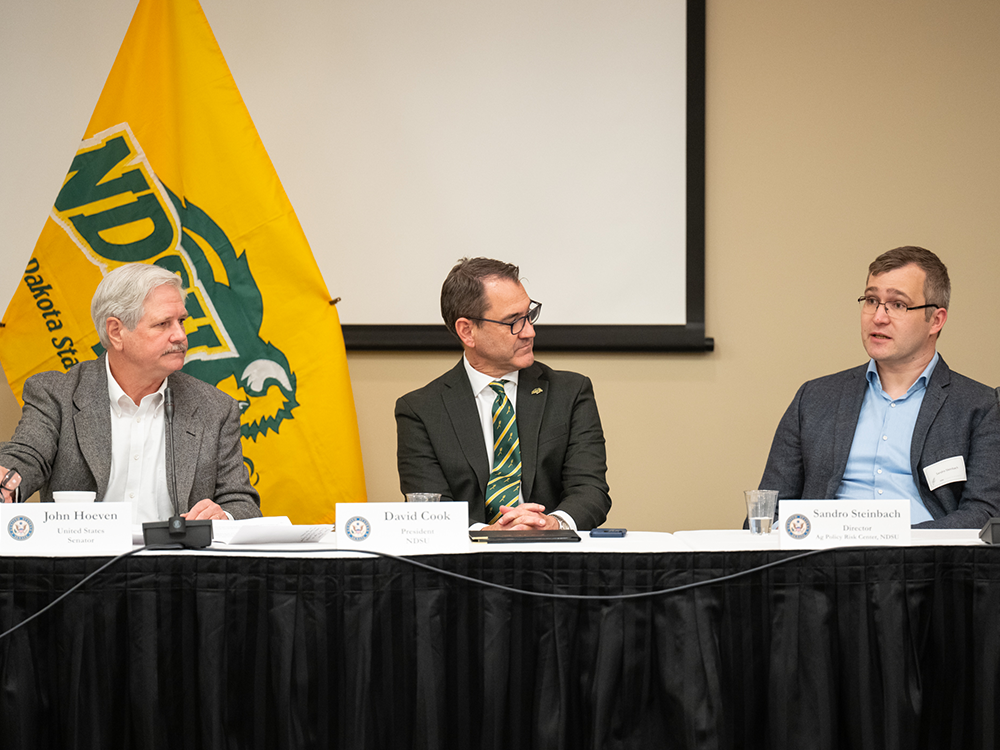
“We serve as a resource to inform national discussion when it comes to new farm policies or changing existing ones,” ARPC Director Sandro Steinbach said. “Our work is driven by the needs of stakeholders, not only in Washington, D.C., but across the region. Many of the questions we take on originate directly from producers, commodity groups, and state-level partners. That regional perspective ensures our analysis remains grounded in the realities that matter most to Midwest agriculture.”
Complementing the work being done at the Food and Agricultural Policy Research Institute at the University of Missouri and the Agriculture and Food Policy Center at Texas A&M, ARPC highlights North Dakota’s and the Upper Midwest’s agricultural economics expertise.
“Agriculture in the Upper Midwest is very different compared to agriculture in other regions, and we’re thinking about ways to make sure that the voice of farmers in the Midwest gets a bit more bandwidth in Washington, D.C.,” Steinbach said. “North Dakota alone grows more than 50 different commodities. That level of diversity creates a much more complex production environment than in states with monoculture-dominated production systems. Having a policy resource located in the Upper Midwest, one that understands that complexity and can respond with region-specific expertise, brings real value to producers.”
North Dakota U.S. Senator John Hoeven, chairman of the Senate Agriculture Appropriations Committee, has been a strong proponent of ARPC and has helped secure nearly $6.5 million in funding since FY24, including an additional $2.5 million in the FY26 agriculture funding bill.
“NDSU’s Ag Risk Policy Center is just over a year old, but it has already proven to be a key tool for policymakers and is shaping our nation’s ag policy to the benefit of farmers and ranchers as we speak,” said Hoeven in a November 2025 statement. “North Dakota has long been a powerhouse in agriculture, but with these latest initiatives in agriculture policy, we are truly taking our leadership to the next level.”
Proven itself, it has. When it was established in the fall of 2024, ARPC hit the ground running and hasn’t slowed down since.
“We did a lot of the background work and policy evaluation for the programs that are in the OBBB (One Big Beautiful Bill),” Steinbach said. “When you think about changing farm policy, you need to be confident that the proposed adjustments will truly benefit the producers who depend on them. Our job is to evaluate the implications, identify potential distributional effects, and ensure the outcomes are fair across the agricultural system.”
No matter what policy ARPC is analyzing, it remains independent and nonpartisan. The organization provides objective, evidence-based research that helps decision-makers understand the economic implications of different policy options.
“The impartiality of ARPC is crucial for growers across the Prairie Grains region,” Sorenson said. “When making decisions, our legislators and industry stakeholders need unbiased information to guide them. They can trust that the research from ARPC is objective and equitable.”
And those impartial answers are found and relayed promptly.
“We invested in the data infrastructure and human resources to make sure that we are the go-to platform that can provide reliable economic and policy insights in a timely fashion,” Steinbach said. “Producers and policymakers don’t have the luxury of waiting months for answers. Timely analysis, whether it comes within a few weeks or even the next day, can be decisive when it comes to risk management and farm policy.”
At the center of everything ARPC does are farmers and rural economies. By providing informed policy solutions and strengthening market stability, ARPC’s work provides tangible results for producers in the Midwest.
“I think that’s what I dreamed about when coming to North Dakota; that the work that I do has a positive impact on the livelihood of farmers and ranchers,” said Steinbach, who grew up on a farm southeast of Berlin, Germany. “The ability to deliver timely, objective policy analysis helps producers in the Upper Midwest make more informed decisions, and that ultimately strengthens the economic foundation of rural communities across the region. That impact means a great deal to me.”