On any busy farmyard, it’s common to see people coming and going throughout the day, but on the Mark Jossund farm it’s more than just seed dealers, agronomists and farmhands running back and forth from the field. Also making regular appearances are international trade teams eager to get a better perspective and understanding of the high-quality wheat they’re purchasing and the farms that are growing it.
Jossund’s involvement in agriculture via the Minnesota Wheat Research & Promotion Council (MWRPC), U.S. Wheat Associates (USW), Agricultural Fertilizer Research and Education Council and more, plus his location and size and style of farm have made him a go-to anytime trade teams are in the region.
“What makes Mark and his farm a great destination is his dedication to education and promoting the hard red spring wheat we produce,” said MWRPC Executive Director Brian Sorenson. “His farm is a good representation of the average family farm in Minnesota, he uses a lot of the new technologies and precision tools that are available and he does a very good job explaining to those trade teams how he uses those tools to produce a consistent and high-quality wheat crop.”
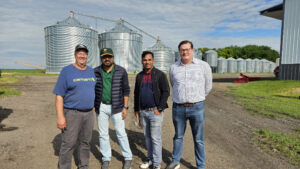
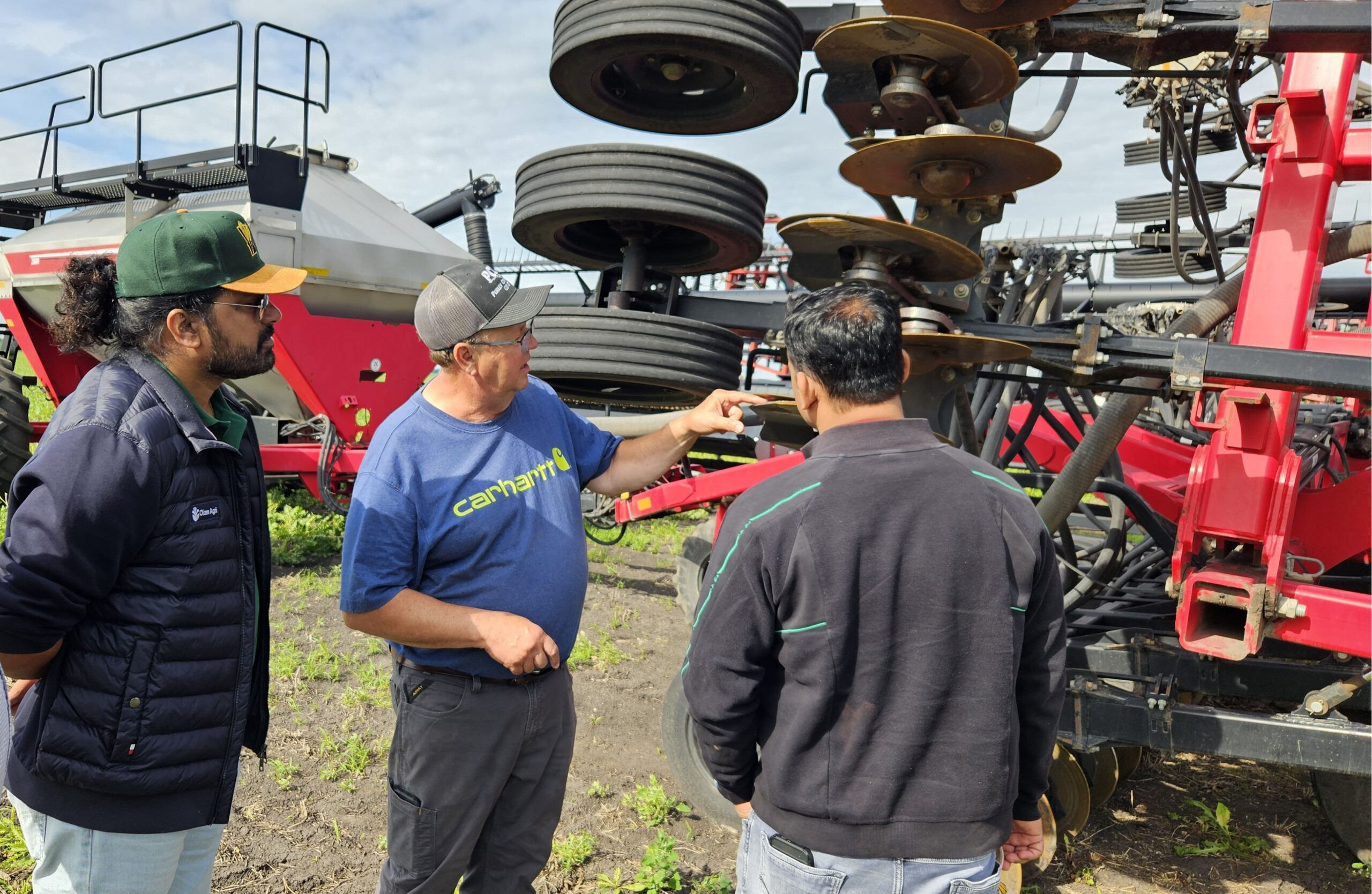
In 2026, Mark has already welcomed two teams of international guests, including the Sub-Saharan African trade team from Nigeria in June and another from Japan in July, both of which were organized through U.S Wheat Associates. The small group from Nigeria consisted of wheat millers and purchasers. During the visit, the delegation toured one of Jossund’s wheat fields and took a closer look at his farm and equipment.
“They were really interested in the equipment we were using. There’s a different piece of equipment to plant corn and another for wheat, and they were very interested in that,” said Jossund, who recently termed off as MWRPC chair. “Then we headed out to a wheat field where I showed up a field of Torgy. They seemed very intrigued with everything.”
Following their visit at the Jossund Farm, the trade team then headed to the University of Minnesota-Crookston to tour the Hard Red Spring Wheat research plots and then visited the farms of fellow MWRPC Directors Rhonda K. Larson and Jeff Larson near East Grand Forks. They also toured the Valley United Co-Op in Halstad and North Dakota State Mill.
Paying dividends
Nigeria is a developing market with a very robust milling industry, typically buying lower priced wheat from around the world, with occasional purchases of higher protein wheat from Canada and the U.S., Sorenson said. The country’s trade team visit was apparently impactful enough, as it triggered a 100,000 MT purchase, or about two shipping vessels worth, of U.S. HRS wheat within a few weeks of their return to Nigeria.
“We talk about the importance of these trade teams to build relationships and plant a seed for future purchases, so to have them go back to their companies and almost immediately make a purchase is wonderful!” Sorenson said. “I wish it was always that quick, but it was certainly a pleasant surprise.”
Just under a month later, Jossund hosted his second trade team of the year, when a small group of mid-level management representatives from Japan arrived at his farm. During the visit, the team was most intrigued about learning about herbicide and other treatments applied during the HRS wheat growing cycle.
“Their market is very concerned about quality and food safety, so we explained that everything we use, even Roundup, which we don’t use on our farm, is safe to use as long as you follow the label,” Jossund said. “So, we went through our fertilization practices, our herbicide practices and fungicides with them.”
Sorenson adds that Japan, whose milling and baking industry is very mature and has long been a top buyer of U.S. wheat, has always been focused on quality. However, sales of HRS wheat have slumped in recent years.
“They’re a high-quality buyer, but they also buy winter wheat as well and a lot of soft white out of the PNW,” Sorenson said. “Their hard red spring wheat sales are strong, but have decreased in recent years due to pricing issues versus Canadian Western Red Spring Wheat.”
The Japanese team also visited the Alton Grain Terminal near Hillsboro, N.D., to learn more about the transportation of commodities and toured the North Dakota State University Wheat Quality labs in Fargo during their time in the region. Jossund notes that these trade visits are very important because of the connections they can make as farmers with the people who are buying their wheat.
“Especially with these two groups, they really like to see where their product is coming from. They like to meet you and they like to see your operation,” said Jossund. “And I think it’s important that we do a good job of raising a quality crop for them and that they get to see that.”
While Jossund has trade teams from several different countries over the years, all with their own unique cultures, languages and interests, he notes that there is one trait they all have in common.
“They’re all very amazed by our vast, flat landscape here in the Red River Valley,” Jossund said. “It’s a 35 minute drive to our farm from Fargo, and there’s not a single hill in sight, and crops as far as their eye can see.”